A popular tap-2-earn app, Tapswap, powered by TON Blockchain, has said the token allocation to users has been indefinitely postponed as the representatives are seeking the best ways to reward the tap-to-earn gamers.
This was disclosed by a Head of Communications, Tapswap, John Robbin, on an X space on Wednesday.
The app, which required users to repeatedly tap the icon in the centre of the Telegram Tapswap bot screen to mine coins, recently gained momentum among Nigerians tapping on their phone screens in pursuit of financial earnings and has amassed over 50 million users since it launched on February 15, 2024.
According to him, the method of token allocation has not yet been ascertained, stressing that the processes cannot be communicated before the allocation.
Daurans. That is, people from President Muhammadu Buhari’s home town of Daura in Katsina State, are a lucky people. Their son, on December 17, while marking his 79th birthday in Erdogan’s Turkey, announced that when he finishes with the Nigerian presidency in 2023, he would retire to the town and take charge of his farm and cattle ranch. Yes, while his government backs open grazing, he points in the direction of ranching. Isn’t it better to do what I do rather than do what I say?
If Buhari fulfils his pledge of returning to Daura, the tight security in the town which makes it an oasis of security in a state where bandits are on rampage, is likely to be maintained by the Nigerian state.
Indeed, even with reduced attacks, including the abduction of school children, the statistics of banditry attacks in Katsina State remains frightening with bandits seizing towns and imposing their own government, including taxes. The Secretary to the State Government, Dr. Mustapha Inuwa, revealed on Thursday November 18, 2021 that between July and October 2021, no fewer than 213 persons were killed by bandits in the state, while 676 others were kidnapped.
But despite the despair, dislocation and hunger in the land, Nigerians should be hopeful because the President promised that “between now and that time, I will do the best that is possible to advance the interest of the nation and its people…”.
However, one of his predecessors both as military dictator and civilian President, Olusegun Obasanjo asserts that Buhari has done his best and could do no more: “Buhari has done his best. My prayer is that God will spare his life to see his term through, but what do we have after Buhari? What should we do to make post-Buhari era better than what we have now?”
But some angry, or is it hungry youths- part of the hordes Buhari had referred to as idle youths- attacked Obasanjo for his position. They argued that Buhari had tremendously improved the security situation in the country. These youths are like the proverbial farmer Obasanjo talked about in the 1980s who has 100 tubers of yam to harvest, but says they are 200. He argues that the farmer would harvest 100 tubers and 100 lies.
Both Buhari and Obasanjo are retired army Generals. Now, the Nigeria Army, before Obasanjo and Buhari joined, and after they retired, has not had a good public image. Nigerians often associate soldiers with impunity and brutality. Unlike the Police which is never tired telling a sceptical populace: ‘The Police Is Your Friend’, the military makes no such pretentions. Soldiers in contempt, used to, or still refer to Nigerian citizens as ‘Bloody Civilians’.
In one of the most infamous cases in contemporary times, a video surfaced in 2016 showing a Federal Government employee, Mr Amari Sunday, being battered by soldiers, including female cadets. In it, a female cadet was repeatedly slapping Sunday for allegedly saying she was beautiful.
UNKNOWN gunmen have allegedly attacked a police checkpoint at the Obosi Interchange along the Onitsha-Owerri road in Anambra State, killing two policemen and burning one patrol vehicle.
An eye witness said about 10 policemen were at the checkpoint at the time of the incident.
According to the eye witness, there was pandemonium during the incident, forcing the policemen to vacate the scene, thereby clearing the checkpoint immediately. It was also gathered that before the shooting incident, traffic gridlock in the area was almost stretching to about two kilometers.
The eye witness said: “The traffic almost got to Upper Iweka Junction. At a point, it became a no movement situation on both lanes of the road.
“I was in the traffic when we suddenly heard gunshots and before you knew it, everybody, including the policemen, started running. They shot two policemen dead and burnt their vehicle.
“The place was brutal yesterday . I think their targets were the policemen who mounted a checkpoint, which caused a horrific traffic situation on both lanes, made worse by the ongoing road construction in the area”.
The state Police Public Relations Officer, PPRO, Ikenga Tochukwu, who confirmed the incident said two policemen were killed.
“What happened along the Obosi Idemili flyover is an example of the price we pay as police officers in service to the nation and humanity.
“Three of the armed men were demobilized, while two police personnel paid the supreme price. The police also recovered the rifles of the slain officers. A Lexus SUV, one of the operational vehicles of the armed hoodlums was also recovered. The operation is still ongoing. Further details shall be communicated.
“The Anambra State Police Command is firm and the personnel are more motivated in providing security services until the current security concern is reduced to the barest minimum and overcome,” Ikenga said. Strike again,
A 61-year-old “Pastor”, Famakinwa Ajayi, has been arrested by detectives attached to the Ondo State Police Command.
He was arrested for allegedly raping and impregnating a 16-year-old girl.
The clergyman, according to the police, carried out the act under the pretence that he was carrying out deliverance on her.
The incident occurred in Ogbese town, Akure North Local Government area of the state.
Parading the suspect before journalists in Akure, the state capital, spokesperson of the police command, Mrs Funmi Odunlami, said the suspect will be charged to court after the completion of investigation.
Odunlami said he victim narrated how the suspect at one occasion deflowered her in his house and later took her to a market square at night and had carnal knowledge of her under the pretence of taking her for spiritual deliverance.
She said, “Famakinwa Ajayi Aged 61 years who is a clergy man impregnated the sixteen year- old girl.”
According to her, the suspect confessed to have slept with her once in his living room.
“He will soon be charged to court for prosecution”, she said
This year, Buddhist Global Relief has launched a new partnership with CAMFED (Campaign for Female Education), a pan-African organization combating poverty, inequality, and injustice by educating girls and supporting young women to become leaders in their communities and nation. CAMFED’s collective efforts have helped almost 5 million girls go to school in Ghana, Malawi, Tanzania, Zambia, and Zimbabwe, and the movement intends to support 5 million more girls over the next five years. For CAMFED, education is a fundamental right and a matter of justice. The organization regards girls’ education as a key to tackling our most pressing global challenges. CAMFED catalyzes the power of the most vulnerable girls and young women to create the future they imagine—for themselves, for their communities, and for Africa.
The partnership between BGR and CAMFED is focused on a project in Malawi that will support the education of 1,333 marginalized girls and young women, providing them with the critical support they need to pursue their studies. In Malawi, a majority of people live in extreme poverty; 62 percent of the population lives on less than $1.25 per day. Malawi is one of the least developed countries in the world, ranking 171 out of 189 countries in the 2018 UNDP Human Development Index. Many families are unable to afford school costs for their children, and when resources are available, they are generally allotted to boys, leaving girls without a formal education. Furthermore, when they reach adolescence, girls are pressured to marry in order to reduce the financial burden on the family.
The partnership between BGR and CAMFED delivers individually tailored support and crucial supplies for the girls to continue learning. These school-going costs are assessed on a case-by-case basis; they include food, school fees, uniforms, sanitary wear, bedding, medical costs, personal protective equipment, and remote learning resources for those without access to digital learning platforms.
CAMFED was founded in 1993 by Ann Cotton. It began in Zimbabwe with scholarships to a group of 32 girls. By 2021, the number of children served had grown to nearly 5 million. CAMFED post-secondary programs are implemented by members of CAMA, the CAMFED Alumnae Association. Established in 1998, the CAMFED Association now consists of 180,000 alumnae of CAMFED’s programs. They are women leaders who demonstrate how education can break the cycle of poverty. CAMA provides a structure for the women to continue their work and grow their activism and leadership. As CAMFED beneficiaries become professionals, they give back their time, expertise, and financial support to the association.
In implementing the BGR project, CAMFED Association members identify which girls in their communities need the most urgent support. Without this support, many girls will not return to school, especially those “invisible” school-age girls who are currently not being reached by—or falling through—existing services and safety nets. On average, each CAMA member is helping three girls go to school; this is what CAMFED calls the “multiplier effect.” Because the members live in the communities where CAMFED operates, they are uniquely equipped to identify and support the most at-risk children. Additionally, in 2017 the CAMA Fund was launched, bringing formality and structure to the Association’s initiatives. Many CAMA members also contribute directly to the fund with their own financial resources, joining a wide network of donors.
CAMFED also engages more than 300,000 teachers, parents, traditional leaders, local education officers, social workers, and magistrates known as CAMFED Champions. CAMFED’s grassroots-led approach means that communities take responsibility for girls’ well-being and success. The contributions of international donors are matched with local networks and resources for optimal outcomes.
The model used by CAMFED is highly cost efficient, as it provides individually assessed school-going costs for eligible children. The support ranges from tuition and exam fees to bedding, medical expenses, school supplies, and direct food aid, where necessary. Financially, it combines the transparency and rigors of centralized financial systems administered by CAMFED with its alumnae’s experience, insight, and activism.
CAMFED supports girls at the point of leaving secondary school, at a time when young women face a lack of opportunities. Many women are pressured to marry young or migrate to urban centers where they may be exploited and abused. CAMA provides women a six-month Transition Programme, including financial literacy, business planning, reproductive health information, and leadership training. After completing the initial training, women can gain further expert training in specialized skills, including climate-smart agriculture.
CAMFED’s studies have consistently found that the second-highest cause of school dropout for girls—after poverty—is low academic self-esteem. Therefore, CAMFED provides guidance and counseling support in every partner school by trained “Teacher Mentors.” Additionally, the “My Better World” school curriculum is designed to improve students’ confidence, resilience, self-reflection, and autonomy, as well as their critical thinking and problem-solving skills. It also encourages girls to become more aware of their rights, responsibilities, and values.
“Learner Guides” are peer counselors tuned into children’s needs and social challenges in their communities and equipped with the tools and resources to support children academically and socially. The guides provide a bridge between schools, families, and local authorities, as they are exceptionally prepared to protect girls from early marriage and bring them back to school. They are able to deploy their first-hand knowledge and experience where others may lack the time, insight, or resources to persevere. Learner Guides are closely connected to school and local authorities and have child-abuse reporting systems in place. They are at the forefront of social activism and have been recognized by official agencies as essential during the Covid-19 crisis. To date, CAMFED has trained almost 11,000 Learner Guides and in 2020 there were over 4,000 such guides active in Ghana, Malawi, Zambia, Tanzania, and Zimbabwe.
Beyond school, “Transition Guides” support young women to capitalize on their education to become leaders, entrepreneurs, and business owners; to obtain gainful employment; or to enter advanced studies programs. The Transition Guides themselves have access to interest-free loans in exchange for their volunteer work, allowing them to start their own businesses and earn a vocational (BTEC) qualification as a stepping stone to a teacher’s training or career employment. As a result, over 11,000 CAMFED Association members created their own businesses in 2020, notwithstanding the challenges of the pandemic—a true testament to the program’s resiliency and sustainability.
Through its partnerships with schools, district, and national education authorities and networks during the pandemic, CAMFED has supported the safe reopening of schools. In addition, CAMFED has been advocating for the prioritization of the most marginalized children, including those with disabilities, and for investment in a strategic transformation of the education system, ensuring that those without electricity and connectivity are not left further behind.
CAMFED recognizes that investing in girls’ education is one of the most powerful ways to address the climate crisis. Quality education and support for climate-smart livelihoods provide girls with the tools needed to sustain themselves and their families while facing climate change. It is well documented that developing nations with higher levels of female education suffer less loss of life, injury, and displacement due to weather disasters. Educated women are better prepared to champion climate-resilient technologies at the community level. They engage in national and international leadership for sustainability and make personal choices that reduce the level of carbon emissions.
CAMFED has received many awards from different agencies and organizations around the world. In 2021 it was announced as the recipient of the Hilton Humanitarian Prize, the world’s largest annual humanitarian award. The prize is given in recognition of extraordinary contributions toward alleviating human suffering.
Peter Laugharn, president and CEO of the Conrad N. Hilton Foundation, said: “CAMFED has revolutionized how girls’ education is delivered, tapping into local expertise in a way that is sustainable and scalable. The Jury’s selection … speaks first and foremost to its community-led approach and to the power of investing in girls. The pandemic has had a catastrophic effect on families and girls, with estimates that 11 million girls may not return to school as a result of the crisis. The time for the global community to learn from this model is now.”
CKate Zemlo Rivas is a volunteer at BGR. She lives in California and works for the University of California, Davis. Kate is also an attorney focused primarily on assisting immigrants, workers, and children. She has been a student of Buddhism for over ten years.
We can all agree that every child has a right to survive and thrive in his or her life.
This encompasses the right to basic needs, education, love, security and success. Decades ago, the girl child was forgotten, disgraced and segregated. She used to be regarded as a tool to ease the life of man. Girls did not get education and if learning was considered they would only study to primary level and be married off. Inheritance was not their right and they had no say in any subject. Basically, girls existed behind the shadows of boys. Fortunately, educationists, professionals and human activists saw the weakness of the practise and advocated against it. Years later, the girl child has emerged to be a success and a role model to look up to. Around the world, women have emerged to be: political leaders, community leaders, professionals and educationists. Today the community offers its support for the success of girls.
Unfortunately, as much attention was put to lift the girl to higher levels, the society forgot about the boy. The low or no concern towards the boy child has led to deterioration of boys’ performance in several areas including educational performance to social interaction and overall success. This is because, the society was comfortable with the boy child’s situation at the time and unconsciously focused on the girl child to the exclusion of the boy child. In a case study of Eastern Nigeria by Onocha et al. (1999), “The boy-child situation in education”, it was noted that as promotional activities were going towards safeguarding the future of the girl child in Eastern Nigeria, the boys were forgotten and isolated. Thus, their grades and self-esteem in educational institutions drastically dropped.
In another study, “Trends and Emerging Drugs in Kenya: A case study in Mombasa and Nairobi County” by Kahuthia -Gathu et al. (2013), it was revealed that there is tremendous popularity and use of drugs among the youth in Nairobi and Mombasa towns of Kenya. Of the youth engaging in the vice, Sixty five percent (65%) were boys and thirty five percent (35%) girls. It was also revealed through the study that seventy five percent (75%) of the boys in drug related activities dropped out of school. This may support the notion that poor sense of belonging and direction among boys tends to push them to seek other avenues of support and recognition. Important to note however is that, just like girls, boys also long and dream for freedom, education, prosperity, identity and success.
Concluding, every child in this world deserves the right to strive and succeed in life. Every child also deserves love and guidance. No child is better or lesser, thus we should not prioritise our attention on one and leave the other.
Program Instructor and Editor Bill Snyder is the former chair of Guild Freelancers. He’s been a full-time freelancer for seven years. He writes about technology and business for a variety of publications, including InfoWorld, CIO, Stanford’s Graduate School of Business, and the Haas School of Business at U.C. Berkeley.Before setting off on his own, he was a reporter at newspapers including the Contra Costa Times and the Oakland Tribune. He’s worked as a writer, senior editor, and executive editor at tech publications including PCWeek, PCWorld, Business 2.0 and TheStreet.com.Bill is a graduate of San Francisco State University and has lived in San Francisco since college.Bill can be reached at: bill@billsnyder.biz or Twitter @bsnyderSF
Program instructor and editor Annie Sciacca is a member of the East Bay Times Guild committee and the Executive Committee of Pacific Media Workers Guild.She is currently a reporter at the East Bay Times of Bay Area News Group, where she reports on local government in Oakland and other parts of the East Bay, as well as breaking news events around the Bay Area and California. Her coverage of the 2018 Camp Fire in Butte County, Calif. was part of a package of stories that was honored as a finalist for the Pulitzer Prize in breaking news.Annie holds a bachelor’s degree from the University of California, Berkeley, and a master’s degree in political science from San Francisco State University.
Richard Knee is a San Francisco-based freelance journalist who has written for specialty and mainstream publications, covering business, local government and politics, education, labor and sports. He has coached and mentored journalism students at San Francisco State and his alma mater, Cal State Northridge (journalism B.A., 1972). He has a California credential to teach community college journalism and mass communications. His long-time freedom-of-information and First Amendment activism includes a 12-year stint on San Francisco’s open-government watchdog commission, the Sunshine Ordinance Task Force. “Big government isn’t the problem,” he says. “Secret government is the problem.”
David Bacon is a freelance writer and photographer, former factory worker and union organizer. He documents workers, migration, and the struggle for human rights. His latest book, In the Fields of the North/En los Campos del Norte (University of California 2017), documents the lives of farmworkers in photographs and oral histories. His photography has been exhibited in the U.S. Mexico and Europe, and his articles and photo essays have been published widely. He is the co-chair of the Guild’s freelance unit.
STUDENTS 2021
Eliza Partika is studying multimedia at the UC Berkeley Graduate School of Journalism. She currently works as a writer for the UC Berkeley School of Public Health communications team, where she enjoys interviewing sources working on fascinating projects, like her recent story on sisters and BPH students Nazineen Kandahari and Nilufar Kayhani, who started a health education initiative to address health disparities in the Bay area Afghan refugee community. The story was featured on The Berkeley Wire on August 13, 2021. From August 2019 through the start of the pandemic, Eliza worked for the UC Irvine Office of Strategic Communications & Public Affairs writing impact stories on student and faculty research in the sciences – everything from interdisciplinary neuroscience advancements, stem cell and Alzheimer’s research to AI predicting the behavior of wildfires and the ways in which humans process and artistically represent death through the objects once belonging to loved ones. Through July 2021, she interned with KQED as a data research assistant for the California Reporting Project, reading, annotating, and analyzing police misconduct records. She assisted in fact-checking and copy editing KQED’s breaking story on the Bakersfield Police Department’s unaccountability for breaking the bones of 31 people over four months. She reported and mixed a segment for KALW Radio, “Beautiful, Unexpected: Children’s Choir Builds Confidence Despite Virtual Rehearsals” which aired in March 2021. Eliza has traveled on experiential education trips to Israel and the Palestinian Territories with the Rose Project’s Fact Finders Learning Mission and the Olive Tree Initiative, where she heard personal experiences of the Israeli-Palestinian conflict from diplomats, journalists, and citizens on the ground. She is interested in examining and correcting the media’s misrepresentation of communities in conflict and publishing narratives that will reveal the realities of these communities. She is also interested in the politics behind trans-generational trauma, as well as the ability of art to heal generational trauma that comes from prolonged and intractable conflicts. Luke Wrin Piper has watched public support for unions and workers rights wane over the years, making it harder for those without the privilege of accessible higher education to earn a living. The experiences of workers speak for themselves, our job is to hear them. Luke grew up in the 510 (area code) and is currently a journalism student in Oakland, Calif. He is currently editor-in-chief at The Citizen, the Peralta Community College District’s student run publication. He plans to continue writing about labor issues, art, politics and crime in the Bay Area and beyond. He is also currently an intern for On Spec, an international podcast focused on the personal stories of those affected by borders, disinformation and xenophobia. Menel Raach is a journalist and filmmaker from Tunisia and currently a student at Laney studying multimedia. She is passionate about social change through storytelling. She started her career as a reporter for Tunisian television and radio channels. She wrote and shot a short movie The Stranger about violence against children. Menel speaks Arabic and French. Ande Richards is a rising second-year graduate student at the University of California at Berkeley. She unwittingly discovered her passion for journalism when she was thrust into a leadership position at the Los Angeles City College Collegian and Collegian Times Magazine. She sharpened her skills as a long-form features writer, launched her bi-weekly column, Drop Stitch, and developed her eye for photojournalism, earning her awards at the state and national levels. Ande’s reporting often centers on underserved communities locally and abroad. Before the violent protests and recent political upheaval, Ande turned her lens on the people of Haiti, from school children facing less than ideal conditions to prisoners held in decaying facilities from a bygone era. At Cal, Ande contributed to the alumni magazine, California, writing about people and the connections they forged at “The Wall.” She also volunteered to manage the production of the J-school’s sole print publication, Realeyes magazine, where she contributed a photo essay featuring devotees of the slain musician and entrepreneur Nipsey Hussle. Last spring, in a serendipitous turn of events at a job fair hosted by the J-school, Ande was recruited to produce content for an emerging vertical on Advance Local’s N.J.com platform. She readily accepted the position, which will see her uncovering stories about the varied ethnic communities that reside in the state. Before attending Cal, Ande freelanced for Los Angeleno, Pace Newspaper, the Jewish Journal, and “Feminist Magazine” on KPFK-FM. She also served on the Los Angeles Press Club boards and the local chapter of the NLGJA. Ande is embarking upon a road trip across the country to settle into her new role, carting along her rescue pitbull, Ralph, and a burgeoning succulent collection. STUDENTS 2020 Noor Baig is a graduating senior at San Francisco State University, majoring in Journalism and minoring in Race and Resistance Studies. She has been a student journalist since her early high school years and has recently written for Golden Gate Xpress and El Tecolote newspapers. Noor is an active participant and leader of the Muslim community at SFSU and the greater Bay Area, where she was born and raised. Noor is passionate about ethnic media and community building, and hopes use both to influence a more inclusive and educated society. The struggles, joys, and movements of individuals and communities of color are central to her journalism and art. Connect with Noor on Instagram (@noor_baig) and Twitter (@noorbaig_) and check out her work at noorfbaig.wordpress.com. Francisco G Delgadillo, a graduate of San Jose State University started his professional career as an art director with the San José Mercury News in the late 90s. He spent the last two decades in the world of tech as a creative director. Following the 2019 dismantling of the brand creative organization he managed for Oracle, he decided to reconnect with journalism and registered for classes at City College of San Francisco. In the spring 2020 semester, he freelanced and wrote a few stories for the college’s newspaper, The Guardsman, and for EL Tecolote, the longest-running Spanish/English bilingual newspaper in California. Two of his non-fiction essays have been accepted for publication; one this Spring in the college’s literary magazine, Forum; the other this Winter in an upcoming anthology out of Australia, 100 Lives. Contact him at Franciscogd@ymail.com, or Twitter @fgdNews Jocelyn Tabancay is a Filipino-American multimedia journalist. She loves telling stories at the intersection of inequality, race, and health. Jocelyn got her start in journalism by making short documentaries on deportees in Tijuana, Mexico. More recently she has reported on all things COVID-19 related in Modoc County for the Investigative Reporting Program in partnership with the New York Times. Jocelyn currently attends the Graduate School of Journalism at the University of California Berkeley. Her work has been published by KALW, Oakland North, and El Tecolote. She speaks Spanish fluently and Tagalog clumsily. STUDENTS 2019 Maria Sestito is an award-winning columnist and reporter. Originally from New Jersey, Maria started her career in journalism in 2013 as a photographer at The Daily News in Jacksonville, North Carolina. She quickly added “reporter” to her title, becoming the first hybrid reporter/photographer at the newspaper.
Photo by Ekevara Kitpowsong
She moved to the Bay Area in 2015 and spent three years covering crime, courts and breaking news, including the 2017 North Bay wildfires, in Napa Valley.
Maria has won state press awards in North Carolina and California, including best writing and best column. Her column, Jersey Girl, runs every other Sunday in the Napa Valley Register.
While at the Register, Maria curated the newspaper’s Instagram feed and increased its followers fivefold.
Maria is currently a second-year student studying investigative journalism, new media and narrative writing at UC
Berkeley’s Graduate School of Journalism. She is also studying Arabic and the Middle East as a foreign language and area studies (FLAS) fellow. Contact her at maria_sestito@berkeley.edu.
Lisa Martin is a Bay Area journalist and photographer interested in local stories that cover the intersection of business and culture.
Photo by Ekevara Kitpowsong
She has a bachelor’s degree in Literature from the University of California in Santa Cruz and is currently studying journalism and visual media design at City College of San Francisco.
She regularly contributed stories, photography and art to The Guardsman and Etc. Magazine. Her work has won awards from the California College Media Association and JACC. She served as the Arts and Culture editor at The Guardsman for two semesters and will be serving as editor-in-chief during the fall 2019 semester.
Lisa Martin believes that good journalism should always test our assumptions and that storytelling has the power to engage people with information in a way that makes the knowledge imparted feel more real and pertinent.
Lisa Martin is available for freelance reporting, writing, copyediting and photography projects. Contact her at lisamartin.562@gmail.com
Photo by Ekevara Kitpowsong
Dimitri Dominic Bailey, a transplant from Southern California, is finishing up his bachelor’s degree in journalism at San Francisco State University with a focus on both print and online.
As an openly gay person of color and the brother of two gay siblings, his passion revolves around giving a voice to marginalized communities. His goal is serving LGBTQ+ residents by reporting stories concisely and ethically through the utilization of social media platforms. Bailey has worked at KGO radio as an assistant producer for the Brian Copeland show and has helped implement free health services for San Francisco’s State University’s LGBTQ+ students. After graduation, he aspires to work for a print or online publication that focuses on LGBTQ+ issues. Contact him at: Dimitri.bailey@yahoo.com
STUDENTS 2018
Sarah Lapidus is a journalism student at City College of San Francisco. Her work has appeared in City College’s The Guardsman, 48 Hills and El Tecolote. Spring semester 2018 she worked as editor-in-chief of the Etc. magazine.
Born and bred in San Francisco near the Mission district, she grew up speaking Spanish and uses writing to connect and unite her community. Her journey in journalism began after a two-year stint in China when upon returning, she tried working tech, marketing, and food justice social advocacy. It wasn’t until she was able to take classes at City College that she discovered her love of journalism.
With her insatiable curiosity, and appreciation of languages, as well as her love for her city, she is grateful to have found journalism. She hopes that her career will take her to many places where she can connect people and cultures through accurate reporting and writing.
Erin Stone is a freelance researcher for National Geographic Magazine and a multimedia journalist. She is currently an intern with the San Francisco Chronicle on the metro desk. In her work so far, she has tended to focus on trauma, addiction, mental health, and the economic, environmental, and social disparities that people face every day. Her work has appeared in National Geographic, Mother Jones, and the East Bay Express.
Erin’s work has taken her from a rattlesnake roundup in Sweetwater, TX, to a roomful of surgeons performing a liver transplant in Rio de Janeiro, to an old bar in Revere Beach, MA, where she documented the lives of Vietnam veterans, cocaine dealers and Revere natives who frequented the place. In 2014, she received a National Geographic Young Explorers Grant to produce a multimedia project documenting the impact that construction of California’s high speed rail system has had and will have on diverse communities in the Central Valley. She has worked in the heart of American oil country as a reporter for the daily paper of Midland, TX. Her articles there led to the paper receiving a statewide award for compelling coverage of mental health issues.
Erin believes in the power of storytelling to foster empathy and spur real change. With the conviction that healing begins with being heard, she strives to report on people who are often overlooked and issues that are sparsely covered. She is currently pursuing her Master’s at UC Berkeley School of Journalism, currently pursuing her Master’s at UC Berkeley School of Journalism, with a focus on video, narrative writing, and investigative reporting.
Sarah Carpenter is a journalism student at Laney College in Oakland. She was Editor-in-Chief of the Laney Tower for two semesters. During this time, the paper earned the statewide General Excellence award from the Journalism Association of Community Colleges.
She has won JACC awards for her work in writing, photography, cartooning, and design.
Carpenter graduated from San Francisco State University in 2013 with a bachelor’s degree in creative writing. She has published many poems and flash fiction pieces in local publications, and now writes news stories following Oakland’s city council and community activism for the Oakland Post.
Her interests include local politics, playing music, writing, investigating, comedy, and getting to know Oakland through its activism.
Her dream is to create a publication (and other forms of media) that makes it easier for people to follow local issues, and become involved in the issues that matter to them.
She can be reached at: sarahisacarpenter(at)gmail.com
Simon Campbell is a journalist from the UK pursuing a masters at the UC Berkeley Graduate School of Journalism. He is interested in stories that explore overlaps between culture, politics and sports. Recently he has focused his work on immigration.
Originally from London, Simon later lived in Japan and has worked for the Yomiuri Shimbun, Japan and the world’s biggest selling newspaper, and the Jiji Press newswire. He has covered Brexit, general elections, stock and commodity markets, Olympic Games and Premier League soccer.
Simon is part of the new media program at Berkeley. He came to the US to push the boundaries of his work and is building skills in data journalism and narrative storytelling. In 2018 he won an award from the Society of Professional Journalists for a podcast looking at the social importance of high school football.
Myah Overstreet is a rising senior at San Francisco State University (SFSU), majoring in Print and Online Journalism and minoring in English literature. She began her journalism career as a staff writer for her high school newspaper, The Jacket, at Berkeley High School, and has been dedicated to the craft ever since.
She is currently editor in chief of The Issue Magazine, a new media arts and culture publication, published by The Alliance for Media Arts and Culture, where she also works as a consulting producer. Starting next semester, Myah will serve as art director for XPress Magazine, a student-run publication by students in the journalism department at SFSU.
Myah strives to tell impactful stories that spark empathy in not only her readers, but local leaders, lawmakers and politicians. She is dedicated to creating change for the betterment of communities that have no voice. Myah believes that storytelling through both the written and visual arts can make the difference we are all looking for either in our personal lives or in the world. She hopes that her journalism career will take her around the world to report about stories that truly matter.
Brian Howey is a journalism student at Laney College in Oakland.
Howey spent the last ten years traveling around North America, Australia, Asia, Europe, and Africa. His main modes of transportation include hitchhiking and hopping freight trains.
His passions are writing, traveling, playing music, and investigative reporting. The well-known slogan, “Giving voice to the voiceless” is his mantra.
Stories he has covered for the student publication, The Laney Tower, include features on the Alameda County homeless count, a tragic Oakland fire, and a revealing piece about a Laney College presidential candidate.
Attending San Francisco State University is his next educational goal, and after graduation, Howey will be researching his next travel destination.
Twenty years ago, I was honored to be asked by the NYU Journalism School to be a judge for the selection of the greatest works of journalism of the twentieth century. They asked me again ten years ago to help choose the best journalism of the first decade of the 2000s, and again some months back for the years 2010-2019.
The way it worked was that all the judges — comprising the NYU faculty, plus Madeleine Blais, Leon Dash, Adrian Nicole LeBlanc, Wesley Lowery, Greil Marcus, Nilay Patel, Dorothy Rabinowitz, Dan Rather, Frank Rich, David Remnick, Walter Shapiro, Sree Sreenivasan, Sarah Stillman, and yours truly — were asked to submit nominations. Then the full list of 122 nominees was sent out to everyone, and we were to vote for our top ten, in order.
My ballot, including the way I ordered my votes, was admittedly strategic. That is I put a couple of selections in high places not because I could or would make an air-tight case that they were the third and fourth best pieces of journalism of the decade, but because I thought they were absolutely great and they hadn’t quite gotten the recognition they deserved. Conversely, I left out a couple of works because I knew they would (deservedly) get a whole lotta love from the other judges.
Beyond that, I valued works that:
*Afflicted the comfortable.
*(Even better) Comforted the afflicted.
*Displayed disciplined, brave and indefatigable feats of reporting.
*Were stylistically excellent or innovative.
*Moved the national conversation.
*Represented work by a person or organization that had been doing great work for a long time and I felt deserved this level of recognition. (You could call this the John Wayne Oscar phenomenon.)
*I was a bit of a hard-ass on definition of journalism, meaning that I sometimes looked askance at works that seemed to belong more to memoir, essay, or history.
Six of the works on my ballot did not make the top ten. So I will list the six here, in alphabetical order, with descriptions provided by the NYU folks, which I’ll in some cases add my two cents to. And then I’ll give the works that did make it.
The six I voted for:
Matthew Desmond,Evicted: Poverty and Profit in the American City. “An amazing work of immersion journalism.” “Gripping … offers not only a close-up examination of its subjects lives but a meta-analysis of the larger problem.” “The reader understands profiteering from the ground up.”
One thing that excited me about Desmond’s book was the way he landed it on the precise intersection between journalism and ethnography (with a good dollop of public-policy thrown in).
Glenn Greenwald, Barton Gellman, with Laura Poitras and Ewen MacAskill, Revelations of NSA domestic surveillance based on documents from Edward Snowden, The Guardian US, Washington Post. “Changed the world.”
Glenn Kessler and Fact Checker Team,Database of Donald Trump’s false or misleading statements, Washington Post. “A rigorously reported and continually updated list of false statements by the president, numbering more than 19,000 by June 2020. The project is a sterling example of what journalists should do — holding the powerful accountable by using reporting and facts.”
As of July 9: 20,055.
N.R. Kleinfield, “The Lonely Death of George Bell,” New York Times. “A detailed examination of what happens after the death of an obscure hoarder — followed by an account of the man’s life that lifts him out of obscurity. Kleinfield’s article represents the pinnacle of narrative feature writing — scrupulously reported, ingeniously structured, and written with clear-eyed empathy.”
I think I actually wrote that, so I’ll add only that the fact that “Sonny” Kleinfield never won a Pulitzer for feature writing is a scandal and a travesty.
Ira Glass, Julie Snyder, Ben Calhoun, Alex Kotlowitz, Linda Lutton and Robyn Semien, “Harper High School,” This American Life. “At Harper High School in Chicago, twenty-nine current or recent students were shot in the span of a single year. Learning of this staggering statistic, This American Life embedded three reporters at the school for five months” — Peabody Awards website.
This was an admirable package–but I wanted to recognize “This American Life” because Ira Glass’s now venerable program really did create a great and new form without which it would be hard to imagine “Serial” and just about any other worthwhile narrative journalism podcast that’s not just one or two people sitting around talking.
Frederick Wiseman,In Jackson Heights. “From-the-ground-up portrait of a Queens neighborhood in transition, from the dean of American documentarians. Wiseman has been doing amazing work for more than half a century.”
In Jackson Heights is a great piece of work, with the rigor, indelible characters, intermittent exhilaration and occasional frustration (10-minute dialogues in Spanish with no subtitles) one expects in Wiseman, but I voted for it in recognition of his amazing body of work.
“Beautifully written, meticulously reported, highly persuasive …” “The most powerful essay of its time.” “Ground breaking.” “It influenced the public conversation so much that it became a necessary topic in the presidential debate.”
“It’s a masterwork by one of our greatest writers and most diligent reporters. Exquisitely written as it is researched, embracing breadth and detail alike, essential reading to understand America.” “A masterpiece of narrative nonfiction.”
“A chronicle of the #MeToo era.” “A pitch-perfect primer on how to take a hot-button-chasing by-the-minutes breaking story and investigate it with the best and most honorable journalistic practices.” “This is one of the defining issues of our times, one whose impact will be felt for a long time.”
“Unbelievably well written and well reported portrait of a slum in Mumbai.” “Vividly reports on the life of this slum’s inhabitants.”
#5
Michelle Alexander, The New Jim Crow: Mass Incarceration in the Age of Colorblindness.
“The book demonstrates the ways in which the War on Drugs, and its resulting incarceration policies and processes, operate against people of color in the same way as Jim Crow. Powerful on its own terms and crucial as an engine toward transforming the criminality of our ‘justice’ system.”
“Investigative journalist for The Miami Herald, examines a secret plea deal that helped Jeffrey Epstein evade federal charges related to sexual abuse.” “Brown essentially picked up a cold case; without her reporting, Epstein’s crimes and prosecutors’ dereliction would not be known.” “Great investigative reporting.” “Documenting the abuses of Jeffrey Epstein when virtually everyone else had dropped the story. “What makes this particularly compelling for me is that Brown did the reporting amid the economic collapse of a great regional paper.” “A remarkable effort to empower victims.”
“In the aftermath of Hurricane Katrina. This is narrative medical journalism at its finest: compelling, compassionate, and unsettling.”
#8
Nikole Hannah-Jones, Matthew Desmond, Jeneen Interlandi, Kevin M. Kruse, Jamelle Bouie, Linda Villarosa, Wesley Morris, Khalil Gibran Muhammad, Bryan Stevenson, Trymaine Lee, Djeneba Aduayom, Nikita Stewart, Mary Elliott, Jazmine Hughes, The 1619 Project, New York Times Magazine.
“Explores the beginning of American slavery and reframes the country’s history by placing the consequences of slavery and the contributions of black Americans at the very center of our national narrative.” “A definitive work of opinion journalism examining the lingering role of slavery in American society.”
“By contacting hundreds of charities — interactions recorded on what became a well-known legal pad — Fahrenthold proved that Trump had never given what he claimed to have given or much at all, despite, in one instance, having sat on the stage as if he had.”
“The definitive journalistic exploration and documentation of fatal police shootings in America. In a decade defined, in part, by the emergence of Black Lives Matter, this Washington Post project set a new standard for real-time, data journalism and was a vital resource during a still-raging national debate.” “In the wake of Ferguson, newsrooms across the country took up admirable data reporting efforts to fill the longstanding gaps in existing federal data on police use of force. This project stands out both in its comprehensiveness and sustained dedication.
NYU put together a pretty impressive (all things considered) Zoom presentation on the night of the announcements, with almost all the winners on hand to offer appreciation for the honor and heartfelt words about what their projects meant to them.
The photo at the top of the post is a screengrab of David Fahrenthold’s remarks. I was moved to grab it because on his bookshelf (circled in black), I spotted a copy of The Art of Fact: A Historical Anthology of Literary Journalism, edited by Kevin Kerrane and me.
The Office’s medium-term expenditure framework and fiscal strategy paper from 2015 showed that the Buhari-led administration incurred N7.63 trillion in domestic debt from June 2015 to December 2020.On external borrowings, President Buhari increased debt from $7.3 billion in 2015 to $28.57 billion as of December 2020. This means that the president incurred $21.27 billion on foreign loans to the country’s debt portfolio. The country’s exchange rate moved from N197 to a dollar in 2015 to N381 at the end of December 2020.Analysis of consolidated debt showed that the external debt increased by 291.37 percent while domestic debt grew by 86.31 percent in the last six years of the Buhari government.Overall, the Buhari-led government has had an accumulated debt of N17.06 trillion as of March 2021, using the N381 exchange rate. This represents a 173.2 percent increase from when he was elected president in 2015.DEBT PROFILE UNDER JONATHAN’S ADMINISTRATION At the beginning of former President Goodluck Jonathan’s tenure in 2011, the federal government had an accumulated debt of N6.17 trillion.Analysis of the debt figure showed that local debt amounted to N5.62 trillion while foreign debt stood at $3.5 billion (about N548.65 billion, using the exchange rate of N156.7/$1).By the end of 2015, the foreign debt component hit $7.3 billion, while domestic debt increased by N8.4 trillion. The country’s exchange rate also stood at N197/$1. Overall, the federal government component of the total public debt increased from N6.17 trillion in 2011 to N9.8 trillion in 2015, representing an increase of N3.63 trillion or 58.8 percent. YAR’ADUA/JONATHAN’S BORROWINGS Under the Umar Musa Yar’Adua/Goodluck Jonathan-led government between 2007 and 2011, domestic debt of the federal government moved from N2.17 trillion to N5.62 trillion. The foreign component of the debt also increased from $2.11 billion to $3.5 billion within the period.The country’s exchange rate also moved from N116.8/$1 to N156.7/$1.The combined debt profile increased from N2.42 trillion to N6.17 trillion in four years, representing a 155 percent jump Of the debt figure, Jonathan completed the tenure from May 2010 to May 2011 after the death of Yar’Adua. The period saw a surge in the federal government’s debt from N4.94 trillion to N6.17 trillion. This represents a 24.9 percent increase in one year. OLUSEGUN OBASANJO’S TENURE During the tenure of former president Olusegun Obasanjo, the debt level of the federal government reduced from N3.55 trillion in 1999 to N2.42 trillion at the end of 2007.The 8-year term of Obasanjo resulted in a dip in FG’s local and foreign debt level, representing a 31.8 percent decline.The country’s exchange rate was between N98.02 to N116.8 to a dollar during the tenure. Analysis of the figures showed that external debt decreased from $28.04 billion by 1999 to $2.11 billion at the end of 2007. However, the domestic component increased from N798 billion to N2.17 trillion within the same period.aThe huge decline in foreign debt was a result of the substantial reduction following the pay-off of the outstanding debts owed to the London Clubs of Creditors in the first quarter of 2007.
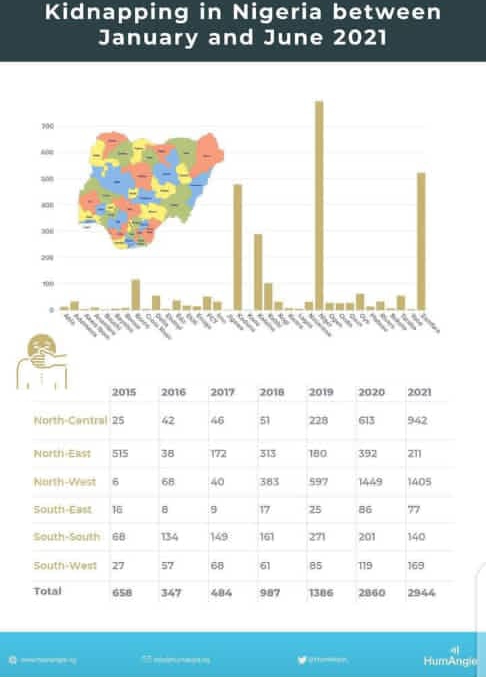
To as well as the total number of people who are victims of kidnapping in the country.While in 2017, there were 484 kidnapping victims, the figure grew to 987 the following year, then 1,386 in 2019, and 2,860 in 2020.Between Jan. 1 and June 30, this year, at least 2,944 people have already been reported kidnapped — making 2021 the worst year yet based on this security index. These numbers are higher if communities along the border areas in Cameroon, Chad, and the Niger Republic are taken into account.The number of kidnapping incidents has increased too, from 110 in 2015 to 135 in 2016, 140 in 2017, 156 in 2018, 330 in 2019, 437 in 2020, and then 315 in the first half of 2021.Another worrisome trend is the increase in the number of mass abductions. The average number of victims per incident has increased over the years from 2.6 in 2016 to 9.4 this year. While there were five abductions in 2015 with over 20 victims, Nigeria recorded 11 of such cases in 2018, eight in 2019, 25 in 2020, and 31 within the first six months of 2021.Young people, especially those enrolled in school, are some of the commonest targets of these large-scale atrocities. This year alone, students have been kidnapped in their tens and hundreds in Kagara, Niger State; Jangebe in Zamfara State; Afaka in Kaduna State; and Yauri in Kebbi State.A tally done by This Day Newspaper estimates that, as of March, over 618 schools had been closed in Northern Nigeria due to the frequent attacks and abduction of students. The affected states included Sokoto, Zamfara, Kano, Katsina, Niger, and Yobe.The numbers from NST also show how the wave of kidnapping has shifted from one region to the other.Back in 2015, the Northeast and South-south had the highest numbers of victims as a result of the Boko Haram insurgency in the former and acts of militancy in the latter. But, a few years down the line, especially in 2020 and 2021, the North-central and Northwest have now become the hardest-hit regions due to spreading terrorism and banditry.This year, states in the Northwest had 1405 victims of kidnapping, followed by the North-central region (942), then Northeast (211), Southwest (169), South-south (140), and Southeast (77).Growing insecurity in Nigeria has been attributed to alarming unemployment rates, the smuggling and circulation of small arms, as well as the understaffing and underequipping of security forces. In a report published last year, research group SBM Intelligence described the problem as the “democratisation of the kidnap industry,” estimating that, between 2011 and 2020, at least $18.34 million was paid as ransom to kidnappers in the country.In a statement released on Sunday, June 11, Nigerian President Muhammadu Buhari urged the military to “respond to the worrying situation in a language that the bandits understand.” He added that the security agencies were working on new methods and policies that had started to yield positive results in the troubled regions. Available data, however, appears to disagree with this assessment.



 Liberty voice